
Opening Remarks for the 5th Indo-Pacific Strategy Forum (IPSF 2025)
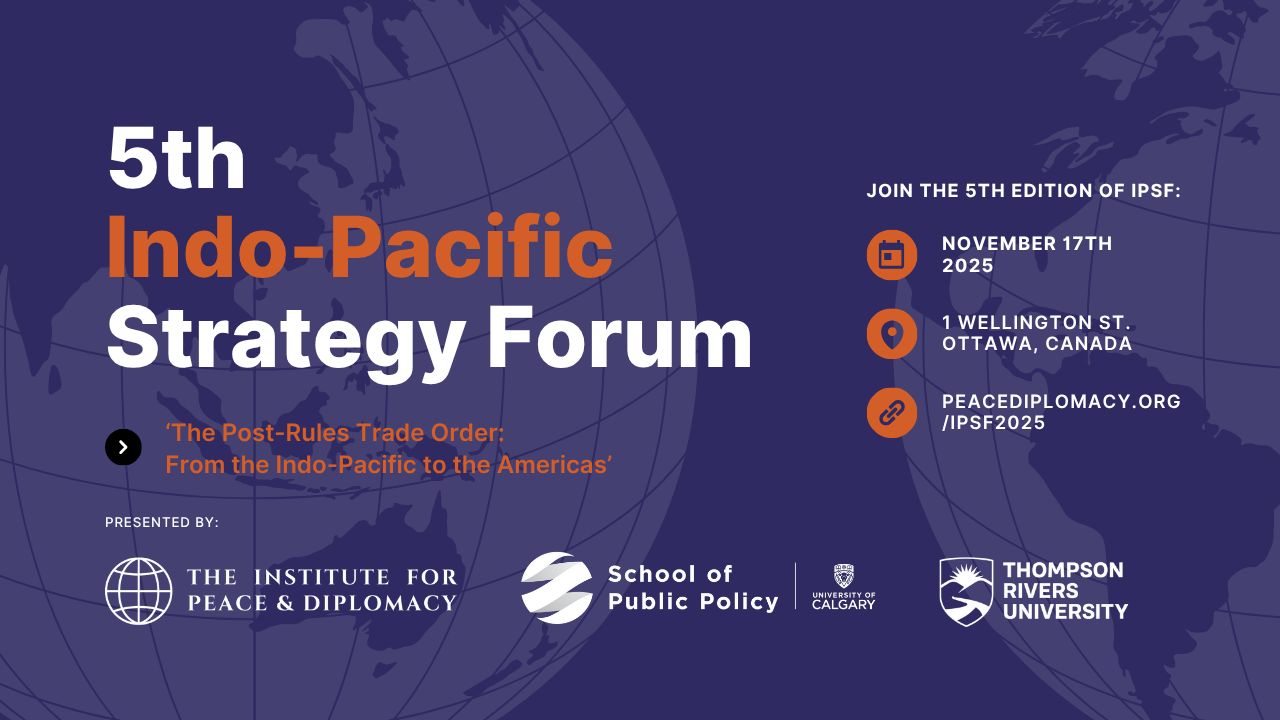
Excellencies, distinguished participants, friends and colleagues: Good morning and welcome to the Senate dungeons at 1 Wellington Street. Let me start by congratulating the Institute for Peace and Diplomacy on putting together this 5th Indo-Pacific Strategy Forum, in partnership with the School of Public Policy at the University of Calgary and Thompson Rivers University.
I am pleased to host this year’s Forum, which is taking place at a key moment in Canadian international policy, when we are rethinking our place in the world and figuring out how to navigate unfamiliar waters in sometimes unfriendly seas. Today’s Forum is also timely because it is an opportunity to provide input on the review of Canada’s Indo-Pacific Strategy, which is only three years old, but already showing signs of misdirection and obsolescence.
On your way to this room, you will have walked the long corridor that looks out onto the historic Rideau Canal Locks – an engineering marvel of the early 19th century that provided an alternative route from Montreal to the Great Lakes via the Ottawa and Rideau Rivers. It was, you might say, Canada’s first “Freedom of Navigation” operation.
The original motivation for the canal was the threat of American hostility along the St. Lawrence River between Montreal and Kingston. That waterway was vital for the transportation of goods and people to and from the Great Lakes, but it was easily cut off because much of the southern shore of the river was under American control. The need to deal with the vulnerability of this water link became apparent when tensions between Great Britain and the United States led to war in 1812 — the last time we had a hot war with the Americans and hopefully the only time.
Freedom of Navigation is, of course, one of the signature purposes of Canada’s Indo-Pacific Strategy. In the same way that the original military motivation for the Rideau Canal was abandoned shortly after the 1812 war, I think we are in a moment where we should also review some of the original motivations for the IPS, such as FON operations. You could also think about the IPS review as adjusting the locks of the canal and changing the water level to facilitate Canada’s navigation of the Indo-Pacific, given the new circumstances we are in.
Without further torturing my analogy, let me get to the meat of my opening remarks, which are intended to put three issues on the agenda for this Forum. I don’t have time to go into detail, but am raising these points in the hope that you will be able to pick up on them in the course of your discussions.
The first is to ask why there is a need today to revisit Canada’s IPS. It isn’t simply that there is greater urgency for diversifying our exports because of American trade actions against Canada. That is certainly one reason why the markets of the Indo-Pacific are more important than ever for Canada, but the idea of Asia as a “plus one” to the US market has always been the reason for Canadian firms to look across the Pacific, especially when market conditions in the US turn sour. It is not a particularly gratifying reason for turning to Asian markets (at least not from an Asian perspective), and there have always been doubts from our Asian partners about whether we will turn back to the US when conditions improve.
Some of you will say that this time is different, and you would be right, but not just in the sense that market conditions and prospects in the US are so much worse today with the Trump tariffs. In fact, the situation today is not simply that Washington is making it more difficult for Canadian businesses to sell into the US market, but it is that the relative decline of American power in the world is giving rise to alternative sources of market demand and global influence that should compel Canada to structurally shift its political and economic attention beyond the United States. That involves “trade diversification” to be sure, but it is a lot more than trade diversification.
The IPS needs a reset, not simply because we need to put more attention on Asian markets for our exports, but because there is a global power shift to Asia that must be accommodated in a way that goes beyond “doubling the share of our exports” outside of the United States. It is more broadly the recognition of a multipolar world in which non-Western powers are gaining greater weight economically, politically, militarily, and in terms of global influence.
Our current IPS is perceived in the region as too closely aligned with U.S. strategic framing in that it mimics American priorities and the priorities of the old order, especially the maintenance of American primacy in the region. We need a reset in the Indo-Pacific, above all, to demonstrate that we recognize the shift to a new, multipolar world order and are capable of behaving as an independent actor in that region.
For starters, and this is my second point, we have to stop pretending that there is such a thing as an Indo-Pacific Strategy apart from a US strategy for shoring up American military and economic primacy in the region. I have long argued that the Indo-Pacific nomenclature is conceptually thin and operationally limited except insofar as it is used as a geopolitical frame for US purposes. There are no meaningful Indo-Pacific institutions as there are in East Asia and the Asia Pacific, and the dense private sector-led production networks that are woven through East and Southeast Asia do not have an equivalent between South Asia and the rest of the continent.
This is not to say that South Asia – India in particular – is unimportant. On the contrary. But it is misleading to tout the Indo-Pacific Strategy as a way for Canada to put more emphasis on India’s massive market when the framing of the Indo-Pacific as such adds no value to the formulation of practical measures for increasing two-way trade and investment with India. By all means, we should have an India strategy, and a Vietnam strategy, and an Indonesia strategy, and a Korea strategy, and a Japan strategy and so on, but there is no master Indo-Pacific strategy within which those country strategies logically connect.
I personally think we should return to less charged terminology, such as Asia or the Asia Pacific, but I understand that our political leaders and bureaucrats may be too invested in Indo-Pacific nomenclature to give it up. In that case, we should at least change the noun to “Framework” rather than “Strategy”, since a “framework” can contain many different and customized country and sub-regional strategies, without pretending that there is an overarching strategy for all the countries apart from geopolitical posturing. I would note that ASEAN uses the term “Framework” rather than “Strategy”, and for good reason.
My third point is that there can be no meaningful Indo-Pacific Framework that does not include China as part of it. Inclusion does not mean agreement with China’s actions — it means recognizing the reality of China as a great power. The fact that our current Indo-Pacific Strategy excludes the PRC speaks volumes about why it is seen as a lightweight version of the US IPS, and why the Indo-Pacific frame is an impediment for us to demonstrate strategic autonomy in Asia. It is not just that we have excluded China from our current IPS, but also that we have gone out of our way to describe China as a “disruptive power” in our strategy document.
I have to give credit to PM Carney for the way he has tried to reinterpret “disruptive” as having both positive and negative dimensions, but I am sure this more charitable interpretation is not what was intended by the original drafters of the IPS. This kind of gratuitous criticism is not found even in the IPS documents of East Asian countries, for which Chinese disruption is real and consequential. That Canada would feel the need to include this phrase in its IPS says a lot about US influence on Canadian strategic thinking. Insofar as “disruption” to the Canadian economy in the current context is concerned, it should be obvious that the threat is much closer to home, but to say as much in a public strategy document would surely be counterproductive.
To conclude, if Canada wants a meaningful future in Asia, we need an approach rooted not in nostalgia for the old order, nor in mimicry of U.S. priorities, but in an honest recognition of multipolar reality and our own long-term interests. That means
- Strategic autonomy in our foreign policy
- Country-specific strategies instead of vague regional constructs
- Engagement with China as a structural actor
- Recognition of a multipolar world
- Alignment with Asian partners’ actual priorities rather than projecting on them what we think they need
As I have come to expect at IPD events, I know the discussions to follow will be vigorous, stimulating, and insightful. I wish you a very successful Forum.